Software Architect & Development Lead
About
I have worked in IT since 2015. I started writing business software on enterprise Java stacks, and over more than 11 years I moved to wherever the problem was more interesting: first designing systems, then leading the teams that build them.
The work that comes my way most often is the work nobody wants to take on: applications running for years, with no trustworthy documentation, that have to keep working while they change. Reconstructing a system's real behaviour from its code and its data has become the skill I am asked for most.
I do not believe in architectures that look elegant on a whiteboard and become unmanageable in production. I believe in written decisions, clear boundaries between modules, and judging a system by how easy it is to change two years from now, when someone else is the one changing it.

What I do
Architecture of long-lived systems
Designing server-side applications on enterprise Java stacks, with clear separation of concerns and data models built to change. Defining REST APIs, relational modelling, and evolving live schemas without taking the service down.
Reverse engineering and legacy recovery
Reconstructing the behaviour of undocumented systems from their code and data. Impact analysis before every change, process re-engineering, and migrating applications onto sustainable platforms while keeping operations running.
Technical leadership of development teams
Acting as the technical reference across parallel workstreams: splitting the work, managing priorities, reviewing implementation choices, and estimating effort and timelines. Constant attention to the growth of the people on the project.
From prototype to published product
Products taken all the way to real distribution: mobile applications published on the stores and libraries released on official registries, with versioning, licensing and documentation. Interface and experience design included.
In public
Part of the job is making the work legible to people who do not write it.


Presenting is not an appendix to the technical work. It is the moment a system stops being an abstraction and becomes something people can try: taking augmented reality applications in front of an audience means explaining in a few minutes, to people who will never read the code, why a design decision changes the outcome.
Industry fairs serve the same purpose from the other side: listening to the problems other people have before proposing solutions. It is the fastest way I know to find out whether what I am building matters to anyone besides me.
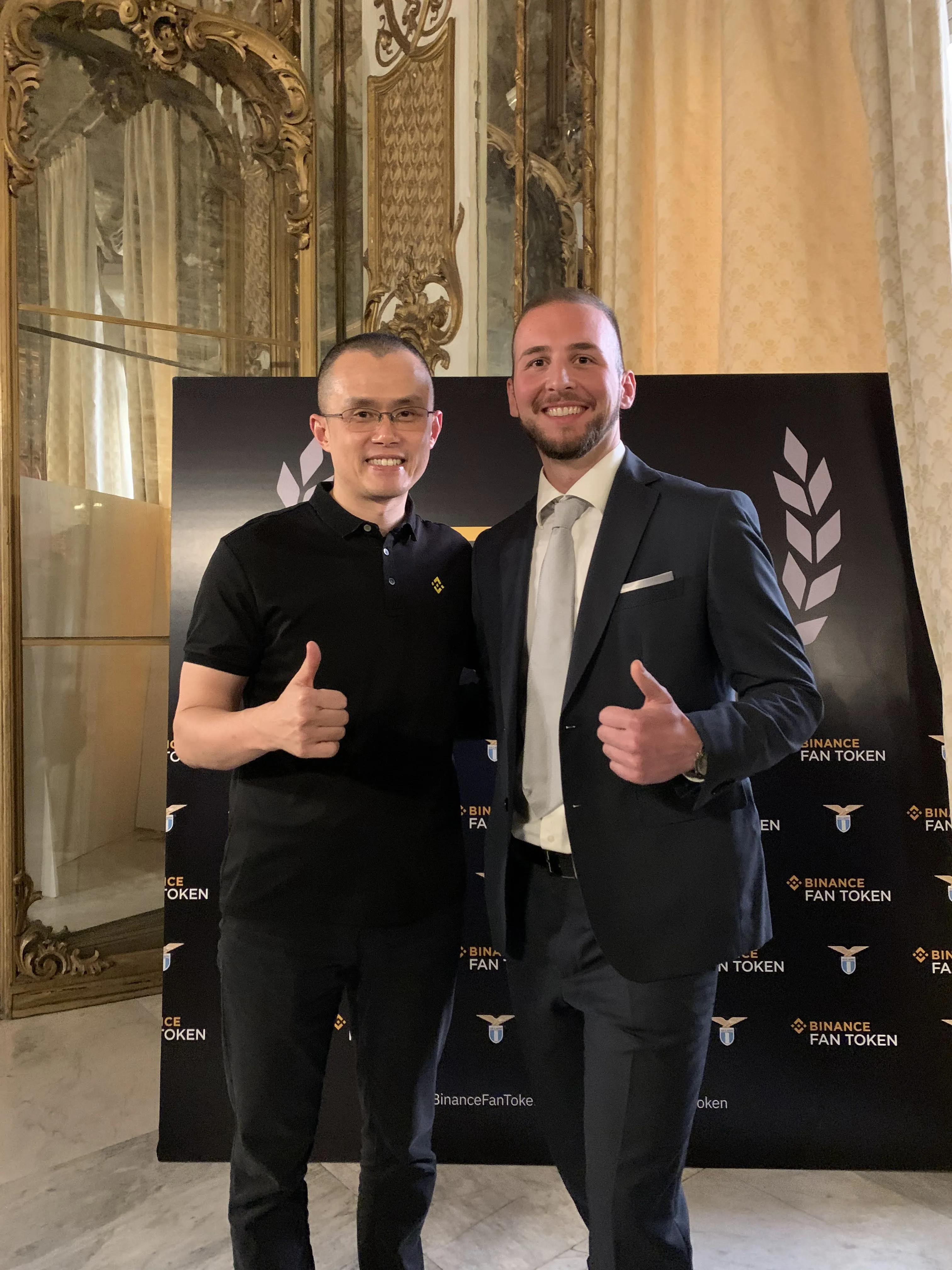
Outside day-to-day work I follow the blockchain space out of personal curiosity: I have experimented on my own with smart contracts and market mechanisms like NFT arbitrage, though it isn't part of my professional work today. At Blockchain Week Rome I attended CZ Meet Italy, the event with Changpeng Zhao, founder of Binance.
On YouTube
Short videos, in Italian, on technology and AI: the latest news, explained simply.




Certifications
A selection, all verifiable at the source. The full profile is on Credly.

Google Cloud · 2025
Professional Machine Learning Engineer
Designing and productionising machine learning systems.
Verify ↗
Amazon Web Services · 2025
AWS Knowledge: Architecting
Core services, networking, compute and storage in cloud architectures.
Verify ↗
The Linux Foundation · 2025
LFD125: Security for Software Development Managers
Security as a responsibility of whoever leads the team, not only of whoever writes the code.
Verify ↗
The Linux Foundation · 2025
LFEL1001: Understanding the EU Cyber Resilience Act
Obligations of the European regulation on products with digital elements.
Verify ↗
The Linux Foundation · 2025
LFS120: Conversational AI: Ensuring Compliance and Mitigating Risks
The European AI Act, ISO/IEC 42001 and risk management in conversational systems.
Verify ↗
Hewlett Packard Enterprise · 2025
Aruba Accredited SD-WAN Professional
Software-defined wide area networking across sites and distributed services.
Verify ↗
Cardano Foundation · 2026
Trust & Digital Identity: Future-Proof Your Enterprise
Digital identity and trust models applied to enterprise systems.
Verify ↗
Chainlink Labs · 2025
Chainlink Fundamentals Certification
Oracles and integration between on-chain contracts and off-chain data.
Verify ↗
Stack
Listing the languages I have worked with made sense when the technology itself was a project's main constraint. With an AI-first approach, backed by coding agents, that constraint is gone: I choose the tool based on the problem to solve, not the other way around. What follows is still the technical background and experience I use every day to guide that choice.
- Languages
- Java
- TypeScript
- JavaScript
- SQL
- Backend and data
- Java EE
- REST API
- PostgreSQL
- LDAP / Active Directory
- Frontend
- Angular
- HTML
- CSS
- Astro
- Mobile
- Android
- Cross-platform
- Practices
- Architettura software
- Reverse engineering
- Code review
- Analisi di impatto
- Technical leadership